

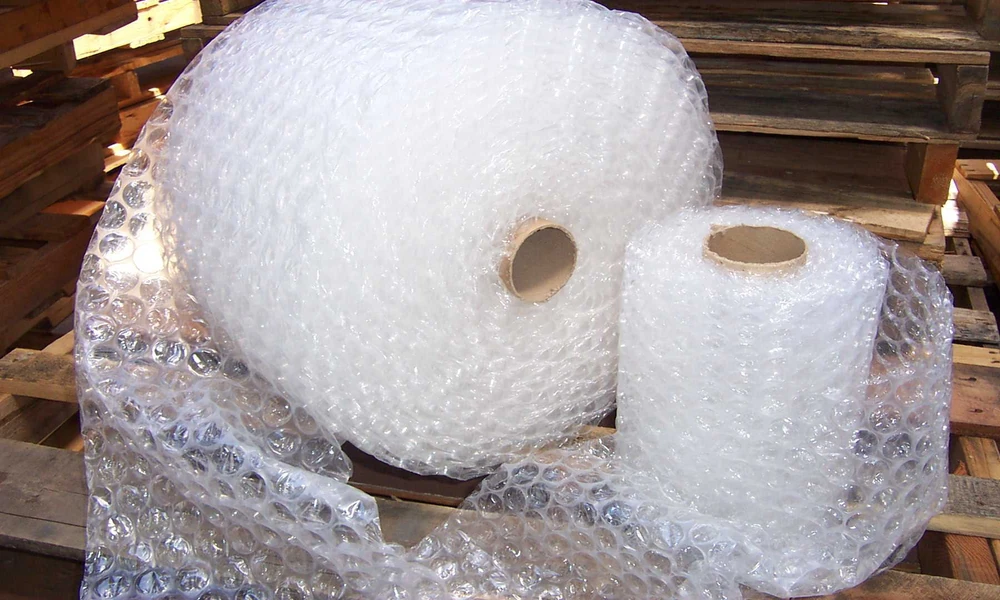
Anyone who has unpacked a new phone, a set of glass jars or a framed photograph knows the crackle of an air bubble roll. It looks simple, just plastic with trapped air, yet the way a bubble roll manufacturer produces it decides whether those bubbles survive a bumpy delivery run or go flat halfway to the customer.
For a small online seller packing ceramic mugs, or a laboratory supplier sending glassware across the country, the grade chosen affects breakage, returns and packing time. Once you understand how the material is made, the specifications on a quotation become much easier to read, and you are less likely to pay for protection your goods do not need.
What Is an Air Bubble Roll Made Of?What Is an Air Bubble Roll Made Of?
Most bubble film is made from low-density polyethylene, known as LDPE. It belongs to the same family of soft, flexible plastic used in many carry bags and stretch films. LDPE suits the job because it is light, tough, moisture-resistant and bonds to itself under heat.
Some producers blend in linear low-density polyethylene to improve tear strength, and some add recycled content. Additives change the behaviour of the film too. The pink film often seen around circuit boards carries an anti-static additive that reduces the build-up of charge when the plastic rubs against a product. Pink film limits charge generation, though it does not block outside static the way a metallised shielding bag does, so very sensitive components are often packed in both.
How Does a Bubble Roll Manufacturer Turn Plastic Pellets into Cushioning?How Does a Bubble Roll Manufacturer Turn Plastic Pellets into Cushioning?
Production starts with LDPE resin in the form of small pellets, which are fed into an extruder. Inside, a rotating screw and a heated barrel melt the pellets into a thick, even mass. This melt is pushed out through a flat die as thin sheets of film, and most lines produce two films at the same time.
The first film travels over a large rotating drum covered in small cavities. Vacuum suction pulls the warm film into each cavity and shapes the bubbles, much like pressing soft dough into a muffin tray. While the bubbles are still warm, the second flat film is pressed over them, and the heat bonds the two layers together, sealing air inside every pocket. This is the lamination stage.
After cooling, the wide sheet is trimmed at the edges and slit into the required widths. Each strip is then wound onto a core as a finished bubble roll of a set length. Some rolls also get perforations for tearing off sheets by hand.
What Is the Difference Between Single, Double and Triple Layer Bubble Film?What Is the Difference Between Single, Double and Triple Layer Bubble Film?
The simplest film has one sheet of bubbles bonded to one flat backing film. Heavier grades add another flat film on the open side, so the bubbles sit sandwiched between two smooth faces, and some grades add further layers again. Extra layers protect the bubbles from puncture and help them hold air on long routes. Labels vary, though. Some producers call bubbles on one backing film single layer and the sandwiched version double layer, while many Indian suppliers sell the same grades as two layer and three layer, so ask any air bubble roll manufacturer how the layers are counted.
Laminated grades go a step further, bonding bubble film to materials such as kraft paper, foil or foam. A kraft paper face resists scuffs and suits furniture and machine parts, while foil versions reflect some heat and help with goods that dislike temperature swings.
How Do Bubble Size and Thickness Affect Protection?How Do Bubble Size and Thickness Affect Protection?
Small bubbles, roughly a centimetre across, hug curves and corners closely. They work well for glassware, cosmetics and boxed jewellery, acting like a padded cloth. Large bubbles, a few centimetres wide, behave more like a cushion and suit heavier items or the job of filling empty space inside a carton so goods cannot slide about.
Bubble height matters as much as width. Taller bubbles absorb more shock but take up more room in the box. Film weight, often quoted as GSM (grams per square metre) or as thickness in microns, tells you how much plastic is in each sheet. A higher GSM film is generally stronger and less likely to burst under a heavy item, while lighter grades suit small parcels and keep courier weight down. As a working rule for choosing an air bubble roll, heavy or sharp-edged products need a higher GSM and sturdier lamination, while light, delicate items do better with small bubbles and a few extra wraps.
Should the Bubbles Face Inward or Outward When Wrapping?Should the Bubbles Face Inward or Outward When Wrapping?
Most packaging guidance says the bubbles should face inward, towards the product, with the smooth side outside. The bubbles then sit directly against the item and soak up knocks, while the flat outer face takes tape and labels cleanly and shields the bubbles from being punctured by neighbouring items. Picture wrapping a wine glass: bubbles against the bowl and stem, smooth side out, then a second wrap the other way.
A few habits make any bubble roll work harder. Wrap fragile items two or three times, leave no gaps between the product and the carton walls, and avoid pulling the film so tight that bubbles burst before the parcel even leaves. Bubbles pressed into freshly polished wood or lacquer can leave faint marks, so some packers turn them outward; tissue underneath is the simpler fix.
What Should Buyers Compare Before Ordering in Bulk?What Should Buyers Compare Before Ordering in Bulk?
A business approaching an air bubble roll manufacturer for monthly e-commerce packaging, for example, will want these points written into the order:
- film weight in GSM or thickness in microns
- bubble diameter and bubble height
- roll width and roll length
- consistency of bubbles across the roll, with no flat or weak patches
- minimum order quantity and typical lead time
Location affects the practical side. An air bubble roll supplier in Mumbai who holds ready stock may deliver faster for urgent needs. An air bubble roll manufacturer in Mumbai producing to order can often adjust widths, perforations or lamination. A sample roll and a few test shipments reveal more than any data sheet.
Can Used Bubble Film Be Recycled?Can Used Bubble Film Be Recycled?
Used bubble film can be recycled, because LDPE is a recyclable plastic marked with resin identification code 4, but whether it actually gets recycled depends on local collection. Plastic film tends to tangle the machinery in mixed waste sorting, so it usually needs to go to a separate film collection point. Reuse is the simplest option: clean, unpopped film can protect several more parcels before it reaches the end of its useful life. Choosing the right grade also means less film per parcel and less plastic waste.
