


A Practical Guide for Modern Businesses
In a fast-evolving tech landscape, the global IT outsourcing market continues to grow at a steady pace — reaching $512 billion in 2024 and projected to exceed $777 billion by 2028 (Statista). As companies seek flexibility, scalability, and access to global talent, choosing the right collaboration model — freelancers, dedicated teams, or managed outsourcing — becomes a strategic decision that directly impacts cost, speed, and quality.
This article breaks down each model, their pros and cons, cost implications, and key decision criteria to help you make an informed choice.
1. Freelancers: Maximum Flexibility for Short-Term Needs
Overview
Freelancers are independent professionals hired for specific tasks or short-term projects. Platforms like Upwork, Toptal, and Fiverr make global access to talent easier than ever.
Pros
- Cost-effective: Average rates are 30–60% lower than agency or full-time developer costs.
- Fast onboarding: You can find and hire freelancers within days.
- Specialized skills: Great for niche expertise or one-off projects.
Cons
- Limited commitment: Freelancers often juggle multiple clients.
- Quality and reliability risks: Skill levels vary widely.
- No long-term scalability: Not suitable for growing or ongoing projects.
- Security and IP risks: Managing sensitive data can be risky without NDAs and access controls.
Best for
- Small projects, MVPs, or design prototypes.
- Companies testing new concepts or exploring market fit.
- Startups with limited budgets and flexible timelines.
Statistics
- 39% of U.S. workers freelanced in 2023, contributing $1.3 trillion to the economy (Upwork Freelance Forward Report).
- 70% of startups use freelancers at some stage of their growth (Forbes).
2. Dedicated Teams: Strategic Extension of Your In-House Staff
Overview
A dedicated team model means you hire a group of developers, designers, and project managers who work exclusively on your project but are employed by an outsourcing partner. You manage them directly, similar to in-house staff.
Pros
- Full control: You manage priorities, sprints, and communication.
- Scalability: Easy to expand or reduce the team as the project evolves.
- Cultural fit: Long-term engagement allows team integration with company culture.
- Predictable cost: Typically fixed monthly rates per developer.
Cons
- Management responsibility: You still need internal technical leadership.
- Longer setup time: Recruiting and onboarding may take several weeks.
- Dependency on vendor: Quality depends on partner’s hiring standards.
Best for
- Mid-to-long-term projects requiring consistency and product knowledge.
- Tech companies looking to augment internal teams with external talent.
- Businesses scaling quickly without opening new offices.
Statistics
- Ukraine, Poland, and Romania remain top destinations for dedicated teams, offering 40–60% lower costs than Western Europe (N-iX, 2024).
- The average dedicated developer rate in Eastern Europe is $40–60/hour, compared to $80–120/hour in the U.S. (Clutch, 2024).
3. Managed Outsourcing: End-to-End Delivery Under Expert Supervision
Overview
In managed outsourcing, a vendor takes full responsibility for project delivery — from planning and architecture to QA and post-launch support. The client defines business goals; the provider manages execution.
Pros
- Minimal management effort: The vendor handles processes, teams, and deadlines.
- Faster time to market: Experienced teams deliver ready-to-use solutions.
- Quality assurance: Built-in QA, DevOps, and project management.
- Access to advanced expertise: Vendors often provide specialists in AI, cybersecurity, or cloud.
Cons
- Less flexibility: Limited ability to change scope mid-project.
- Higher upfront cost: End-to-end service pricing is higher.
- Vendor dependency: Full reliance on the provider’s delivery model.
Best for
- Businesses without in-house tech leadership.
- Complex enterprise projects needing clear SLAs and governance.
- Non-technical founders seeking turn-key development.
Statistics
- Managed IT services market expected to reach $680 billion by 2030 (Grand View Research).
- 59% of companies outsource primarily to cut costs, but 36% cite improved service quality as the key driver (Deloitte Global Outsourcing Survey 2024).
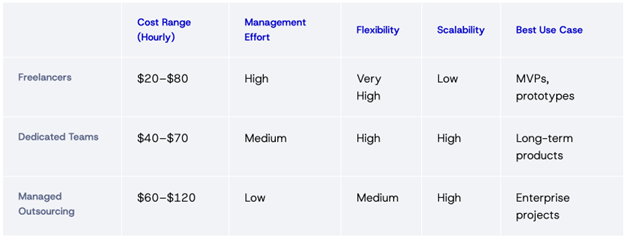
4. Cost Comparison Table
5. How to Choose the Right Model
Decision Framework
Ask yourself:
- Do you have internal tech leadership?
→ If no → go with Managed Outsourcing.
→ If yes → Dedicated Team or Freelancers could work. - What’s the project duration?
→ <3 months → Freelancers.
→ 6–18 months → Dedicated Team.
→ >18 months or complex → Managed Outsourcing. - How important is control vs convenience?
→ Control → Dedicated Team.
→ Convenience → Managed Outsourcing.
Example Scenarios
- Startup MVP: Hire freelancers for fast delivery and cost-efficiency.
- Scaling SaaS product: Use a dedicated team for long-term roadmap stability.
- Non-tech enterprise: Choose managed outsourcing for guaranteed delivery.
6. Conclusion
The right collaboration model depends on your company’s stage, internal capacity, and strategic goals.
- Freelancers offer agility.
- Dedicated teams provide scalability and control.
- Managed outsourcing ensures full accountability and quality.
As global IT ecosystems evolve, hybrid models — combining freelancers for innovation, dedicated teams for core development, and managed partners for delivery — are becoming the new standard for tech-driven growth.
