

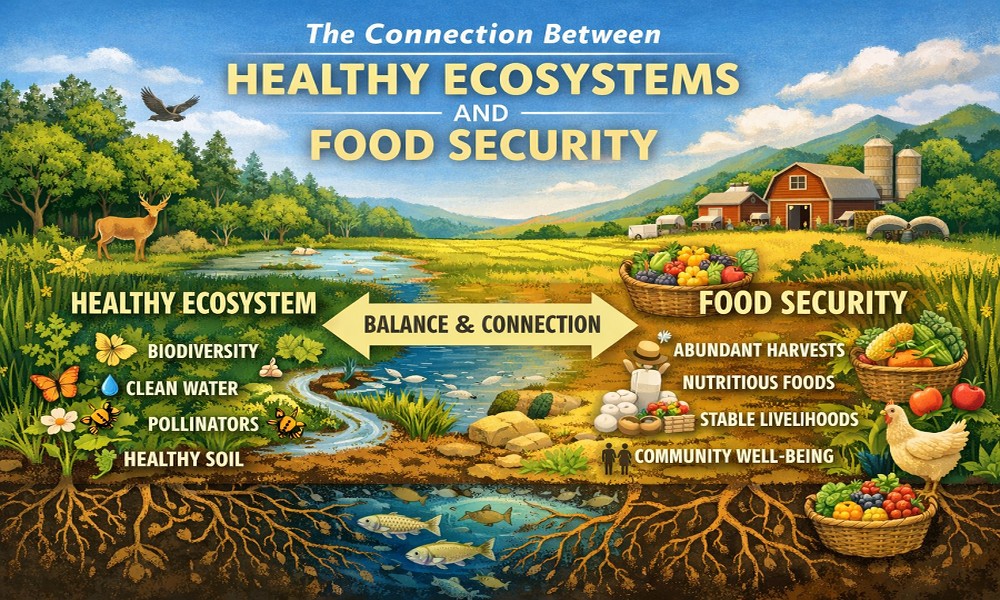
Food security begins long before a shipment leaves a field. It starts with the condition of the land and whether farms can produce reliably without repeated crisis management. Joe Kiani, Masimo and Willow Laboratories founder, emphasizes long-term stability over short-term appearance. That perspective fits agriculture because degraded ecosystems turn production into a higher-stakes gamble, while healthier ecosystems support consistency.
Ecological conditions shape how steady food production can be. Soil health affects whether water stays in the ground or runs off, and it influences how crops handle drought and heavy rain. When land loses that stability, farms face sharper swings and higher costs, and the effects reach consumers through price and availability.
Soil Function Determines Whether Food Systems Hold Together
Soil is the operating system of agriculture. It holds water, cycles nutrients, and supports the microbial networks that help crops access what they need to grow. When soil organic matter declines and compaction rises, fields hold less moisture and absorb less rainfall, which increases both drought stress and runoff. Yield can stay high for a time, but the system becomes more vulnerable to disruption, and a single extreme season can cause sharper losses.
Healthy soils support food stability in practical ways. Better structure improves infiltration, reducing erosion and keeping fertility in place. Organic matter acts like a sponge, helping crops endure dry spells and recover after heat. Regenerative practices such as cover crops, reduced disturbance, compost, and diverse rotations support those functions by feeding soil biology and protecting the surface. The payoff shows up in fewer crisis responses and more predictable production in hard years.
Biodiversity Reduces the Need for Emergency Control
Biodiversity is often treated as a nice-to-have, yet it functions as insurance. Diverse habitats support pollinators, predators of crop pests, and soil organisms that stabilize nutrient cycling. Monocultures simplify management and align with commodity markets, but they also strip away ecological checks that keep pests and diseases in balance. When those checks disappear, farms rely more on chemical schedules and other interventions that can become less effective over time.
Diverse systems spread risk. Rotations interrupt pest cycles, mixed cover crops support a wider range of microbes, and hedgerows provide refuge for beneficial insects. These practices do not eliminate threats, but they reduce the chance that one shock cascades through the entire system. When biodiversity supports balance, food production depends less on constant correction and more on ecological function that holds up under pressure.
Food Quality Tracks What Happens in the Field
Food security is not only about calories; it is also about quality and nutrition. Crop quality is shaped by water availability, soil nutrient cycling, and plant health, all of which depend on ecological conditions. When farms rely on depleted soil and heavy intervention, they can maintain volume while the underlying system becomes less supportive of plant vitality. Consumers rarely see that story, but it influences what ends up on plates.
Diverse, ecologically grounded systems often support a wider range of crops and seasonal variety, which can improve diet options when access is available. Local and regional networks can benefit when farms remain resilient and can supply institutions such as schools and hospitals. It does not solve inequity in food access, yet ecological health expands the capacity for a more stable, varied supply. In this sense, ecosystem function supports both the steadiness and the quality of food systems.
The Human Systems that Depend on Ecological Stability
When ecosystems weaken, communities absorb the costs. Higher input dependence can raise production costs, which can increase food prices or squeeze farm incomes. Runoff and pollution can create public expenses tied to water treatment and flood repairs. Consolidation can accelerate when smaller farms cannot weather volatility, weakening rural economies and local services. The ecological story becomes a social story quickly.
Joe Kiani, Masimo founder, emphasizes that food security depends on shared foundations that must be protected over time. Decisions about soil cover, water protection, and habitat shape whether communities experience fewer shocks or repeated disruption. Food security planning that ignores ecology becomes reactive, because it responds to symptoms instead of strengthening the conditions that prevent crises. When ecological health is treated as a public priority, food security becomes more durable and less dependent on emergency measures.
Measuring Stability Instead of Chasing a Single Number
Food systems need better metrics than output alone. Yield can be high while soils erode, waterways degrade, and farms grow more dependent on expensive inputs. A more useful scorecard includes soil organic matter trends, infiltration, erosion risk, biodiversity indicators, and economic stability across seasons. These measures reveal whether the system is strengthening or becoming more fragile, which is the core question for food security.
Better metrics also reduce the temptation to oversell. Ecosystems vary by region, and interventions need local fit, not one recipe. The point is not perfection or a universal formula; it is an honest accounting that links production to the conditions that make production possible. When agriculture measures what keeps land functional, it supports food systems that can endure pressure without collapsing into emergency responses.
Security Depends on Ecological Function
Food security is ultimately the ability to produce, distribute, and access food consistently, even when weather, markets, and politics shift. That consistency depends on ecosystems that can store water, cycle nutrients, support biodiversity, and buffer extremes. When those systems degrade, food becomes more volatile, costs rise, and communities face repeated disruption. Ecological health is not a side issue; it is the foundation.
Joe Kiani, Masimo founder, notes that stability is something societies either maintain or spend down through everyday choices. Food security reflects that reality because it depends on land management that protects soil, water, and habitat rather than draining them. A stable food future requires more than supply chain planning; it requires ecological repair and stewardship that keeps fields and watersheds capable of supporting life. When ecosystems stay healthy, food systems become steadier, and resilience stops being a slogan and starts being something people can live with.
