

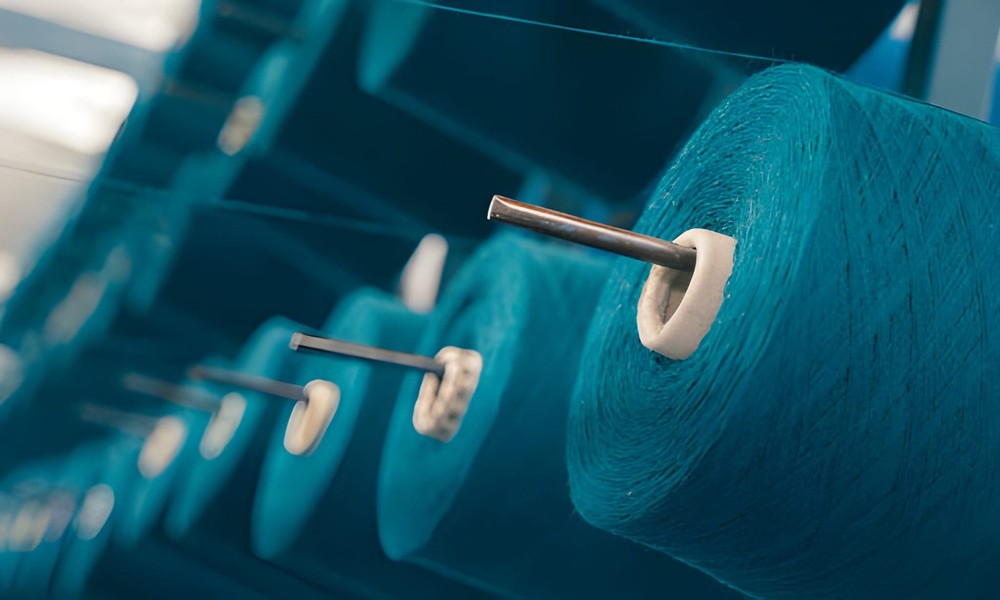
Walk into your room right now and pick any random item a T-shirt, curtain, backpack, even the thread on your bedsheet. There’s a strong chance polyester filament is part of it.
Not because it’s trendy. Not because brands love talking about it.
But because it quietly does its job and does it well.
Most people don’t sit around thinking about yarn types. But if you’re in textiles, sourcing, or even just trying to understand what actually goes into the fabrics we use every day, polyester filament is one of those things worth knowing.
It Starts with Something Surprisingly Simple
Here’s the part that surprises people: polyester filament starts as plastic.
Yep the same base material used in bottles (PET) gets melted, pushed through tiny holes, stretched, and turned into long, continuous threads. That “continuous” part is important.
Unlike cotton, which comes in short fibers that need to be spun together, polyester filament is already one smooth, uninterrupted strand. That’s what gives it strength and consistency.
If you’ve ever worn a shirt that didn’t lose shape or a jacket that still looks new after months this is probably why.
Why It Keeps Showing Up Everywhere
There are a lot of fabric options today. Cotton feels natural, linen feels premium, blends are getting smarter. Still, polyester filament keeps dominating shelves and supply chains.
Not because it’s perfect but because it’s practical.
- It doesn’t wrinkle easily.
- It dries faster than most fabrics.
- It holds color longer.
And it doesn’t give up after a few washes. For everyday use, that combination is hard to beat.
And from a business point of view? It’s reliable. When you’re producing at scale, reliability is everything.
The Part Most People Miss: There Isn’t Just One Type
Here’s where things get real.
A lot of buyers make the mistake of thinking polyester filament is just one standard product. It’s not. The type you choose changes everything from how the fabric feels to how it performs.
POY The “Not Ready Yet” Yarn
This is more like a starting point. It’s not fully processed and usually gets turned into something else.You won’t see it in final products, but manufacturers rely on it.
FDY Clean, Smooth, Ready to Use
This one is finished and polished. If a fabric looks slightly shiny or very uniform, FDY is probably involved. It’s commonly used in things like linings or lightweight garments.
DTY The Comfortable One
This is where things feel more “normal.” DTY is textured, which means it has a bit of stretch and softness. That’s why it’s used in T-shirts, leggings, and even sofa fabrics.
If something feels closer to cotton but still lasts longer, DTY is usually behind it.
The Technical Terms (Without the Confusion)
When you browse yarn listings especially on platforms like GLYarn you’ll see specs that look complicated. But honestly, they’re pretty straightforward once you stop overthinking them.
- Denier – how thick the yarn is
- Smaller number – finer fabric
- Bigger number – heavier feel
- Filament count →-how many tiny strands are inside
- More strands – softer touch
- Luster – how shiny it looks
- Bright – glossy
- Dull – more natural look
That’s it. No need to turn it into a science project.
Where You Actually See It (Without Realizing)
Polyester filament isn’t limited to one category. It’s everywhere, just doing different jobs.
Clothes You Wear Every Day
Sportswear especially depends on it. It handles sweat better, dries faster, and doesn’t lose shape easily.
Things Around Your Home
Curtains, bedsheets, cushion covers it’s all there.
The big advantage? It doesn’t fade quickly, even if sunlight hits it every day.
The Stuff You Never Think About
Seat belts. Ropes. Industrial fabrics.
This is where polyester filament really proves its strength. It’s not just about comfort-it’s about performance.
Why Businesses Stick with It
If you talk to someone in textile production, they won’t hype polyester filament like a marketing brochure.
They’ll just tell you: it works.
- It’s affordable.
- It’s consistent.
- It’s easy to source in bulk.
And when platforms like GLYarn simplify the sourcing process, it becomes even more practical. You don’t have to chase suppliers or worry about unpredictable quality.
What’s Changing Now
Even though polyester filament has been around for years, it’s not stuck in the past.
Recycled Polyester Is Growing
More manufacturers are using plastic waste to create yarn. It’s not a perfect solution, but it’s definitely better than ignoring the problem.
Fabrics Are Getting Smarter
Now you’ll find polyester filament with extra features:
- Moisture control
- UV resistance
- Anti-bacterial finishes
These aren’t luxury anymore they’re becoming standard.
Better Production, Less Waste
Modern machines are more efficient, which means fewer defects and more consistent yarn quality. For buyers, that means fewer surprises.
Choosing the Right One (Without Overcomplicating It)
If you’re sourcing polyester filament, don’t try to memorize everything at once.
Just focus on this:
- What are you making?
- Does it need to feel soft or be extra strong?
- Do you care about shine or a matte finish?
Answer those, and you’re already halfway there. The rest comes with experience.
One Honest Thought Before You Go
Polyester filament isn’t exciting. It doesn’t have the “natural” appeal of cotton or the luxury image of silk.
But when you actually live with a product wash it, use it, depend on it you start to notice what really matters.
- Things that last.
- Things that don’t need extra care.
- Things that just work.
And that’s exactly where polyester filament fits in.
